It’s About Loss
Gospel Reflection Matthew 16:21-28
For those who want to save their life will lose it….
I’ve lost my life so many times. I changed schools every two years of my childhood. I had my children really early — Asher was born when I was 20. Divorce was another loss of life. Being a single parent has not always been not easy. Things with my family have been challenging and painful. I served a church where things were upside down much of the time. I’ve broken up with men that I thought might someday be my husband. I’ve lost my life again and again.
If you know you know.
This week, some of us gathered to watch the new Mary Oliver biography on the PBS show American Masters called Saved by the Beauty of the World. It’s excellent, with gorgeous filmmaking, and it’s very hopeful about the natural world. It’s also so chock full of grief. Oliver’s story is full of loss, of family, of her beloved partner, Mary Malone Cook, of a long life as a poet without any recognition, of a difficult late in life romantic relationship, of moving cross country from her home to place-less Florida.
We can’t spin straw into gold, no matter what the fairy tale says.
Loss is devastating, and even more so when there isn't a place to reflect, to make sense, to grieve.
I have empathy for Peter. If my friend said they needed to suffer and die, I’d hear it like they wanted to die. We look with our clear-eyed backward view, but Peter was in the moment.
He knew who Jesus was. Remember last week? Jesus was Messiah, the one who was anointed.
We don’t got context for that word Messiah these days. Our presidents are elected every four years. There is a peaceful transfer of power. We have checks and balances. I don’t want to speak for all of the Jewish people in the time of Jesus, but many of them longed for an anointed one, following the line of the great King David, the Davidic line. He was anointed by Samuel the prophet at a dinner, as Samuel held his sacred vessel, a sheep’s horn filled with olive oil and poured it on David’s head. It was more than a symbol. Samuel was calling David to be the king, set apart, the one on whom God’s Spirit rested, so that David might be more than himself, one set apart. It wasn’t just the kingship that they longed for. They longed for the anointed one to be a prophet — one who called the people of God into the ways of God, revealing God to God’s people. They longed for him to be a priest — one who intercedes for God’s people. And they longed for him to be king — the one with authority in heaven and earth, with the authority to rout the Romans and to restore the Davidic house to Israel forever.
It’s a lot on any one person’s shoulders, even the one anointed by God, called to be the Savior of the Universe.
Peter saw the potential in Jesus, but it wasn’t what he thought it was. Jesus and his life were about loss. About losing life. About showing us with his very body another way. About the deep loss coming down from heaven for us. About changing the world forever, but in gentle ways, not those ways that twist your arm and force. It wasn't about political power and a horn full of olive oil or routing the Romans and the despot Herod.
Even 2000 years later, we still make these same mistakes. They’re categorical for us humans. We don’t live in the land of light and life, do we?
Our world is full of beauty, goodness, and even truth. But there is so much to be desired, so much that isn’t the way it should be.
We live in empire, just like Jesus did.
We live where might and money make right.
We live with death all around us.
We know and see suffering all around us.
We live where justice is forgotten.
It’s a world much like the one in which Jesus lived, so similar to that of the early church.
And as Christians, we don’t fit well within empire. The virtues of empire — money, power, might, posturing, all of this without joy and without goodness — are not our values. Embracing these values does not make us Christians.
Genuine love helps. Mutual affection does too. Rejoicing in hope, yes to that! Giving freely of your money and your gifts. Showing hospitality. Yes! That helps. All of this leads us toward loss, and also towards the Messiah, Jesus, the king of the universe. His kindom is not of this world. He’s the one who leads like a shepherd, gently calling each of us by name. He’s the one who asks us to be his hands and feet in the world today, to love with genuine affection even when it seems like this kind of loving is far and few in between.
He’s the one whose very presence reminded his followers yet again that the kingdom of God is open not only for the Jews, but also for those who were not God’s chosen people, all of the people of this world.
He reminded God’s people yet again that God’s plan wasn’t just for the men, but also for the women, the non-binary, those who had their sex organs removed, the eunuchs, the non-binary, those who are trans, all the people.
He reminded God’s people yet again that it’s not just those with resources God wants, but the poor, the ones who are broken down with exhaustion and health issues, with mental health struggles.
He reminded God’s people yet again that it wasn’t those who are already perfect who needed God, but the rest of us, who are making mistakes and mishaps every day and knowing it, who are hanging on by a thread, the poor, the disabled, the downtrodden, the abused, the differently abled, those who are rejected by the rest of the world, the ones with great losses, who already know that it means to lose your life.
Because this is the way of God, the strange logic of the king of the universe, the one that goes against everything that makes sense, if we’re looking with eyes of this world. The first shall be last. The meek will inherit the earth. The proud are scattered in the imagination of their hearts. And loss, if you participate in it, letting the light of God shine on it, weeping, mourning, and refusing to pretend that everything is ok, leaning on your community and even accepting help sometimes, that loss turns into great strength.
Because Peter’s mistake wasn’t wanting his friend not to die. It was thinking too small and only thinking in the political realm. It was thinking that the answer to all the problems was Jesus on Herod’s throne. But Herod died, and we remember him only as a foolish despot who tried to thwart the plans of God.
Jesus, on the other hand, changed the course of history.
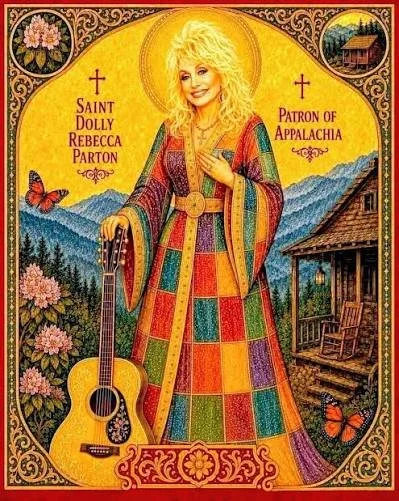
This week, one of God’s beloved ones passed into the land of light and life. Maybe at first blush, Dolly Parton didn’t seem like much. Born into great poverty, she participated. She did what she thought was right. She knew her own belovedness, even though it was so different than the mainstream. And she loved. Fiercely and well. She refused to be unkind. Even though she was a star, she did much of her work behind the scenes. Her “weaknesses” were not what they seemed. They were her greatest strengths, her beautiful triumphs. It wasn’t her money. It wasn’t her wigs. It wasn’t even her body. She was a woman anointed by God to be a different kind of human, one who showed us with her very being, what true religion looks like. She knew that she was beloved and she loved. Just like us.